Определите коэффициенты квадратного уравнения \(\displaystyle (k+1)x^2+(6-k)x+2k+1=0 {\small.}\)
\(\displaystyle a=\)\(\displaystyle {\small;}\) \(\displaystyle b=\)\(\displaystyle {\small;}\) \(\displaystyle c=\)\(\displaystyle {\small.}\)
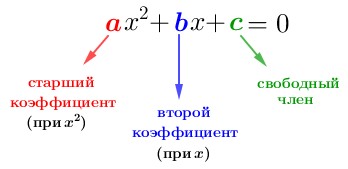
Перепишем \(\displaystyle (k+1)x^2+(6-k)x+2k+1=0 {\small,}\) выделив явно коэффициенты при \(\displaystyle x^2{\small,}\) при \(\displaystyle x{\small}\) и свободный член.
Получим:
\(\displaystyle \red{(k+1)} \cdot x^2 \color {blue}{+(6-k)}\cdot x\color {#009900}{+(2k+1)}=0{\small .}\)
Тогда
\(\displaystyle \red{a=k+1}{\small,}\) \(\displaystyle \color {blue}{b=6-k}{\small ,}\) \(\displaystyle \color {#009900}{c=2k+1}{\small .}\)
Ответ: \(\displaystyle {a=k+1}{\small,}\) \(\displaystyle {b=6-k}{\small ,}\) \(\displaystyle {c=2k+1}{\small .}\)