На рисунке даны две пересекающиеся прямые. На одной прямой выбраны точка \(\displaystyle A{\small,}\) \(\displaystyle B\) и \(\displaystyle C{\small,}\) а на другой – точки \(\displaystyle A_1{\small,}\) \(\displaystyle B_1\) и \(\displaystyle C_1\) таким образом, что \(\displaystyle AA_1 \parallel BB_1 \parallel CC_1\) и точка \(\displaystyle B\) лежит между точками \(\displaystyle A\) и \(\displaystyle C{\small.}\) Найдите \(\displaystyle A_1C_1{\small,}\) если \(\displaystyle AB=1{\small,}\) \(\displaystyle AC=4{\small,}\) \(\displaystyle B_1C_1=6{\small.}\)
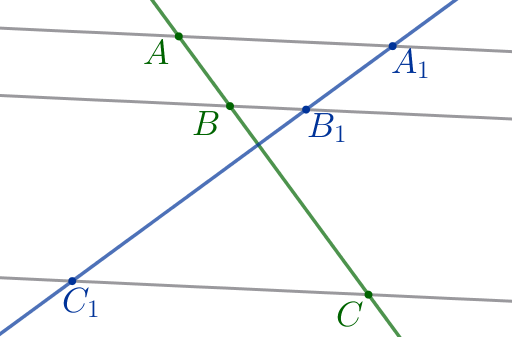
\(\displaystyle A_1C_1=\)\(\displaystyle {\small.}\)
Отметим на рисунке длины отрезков.
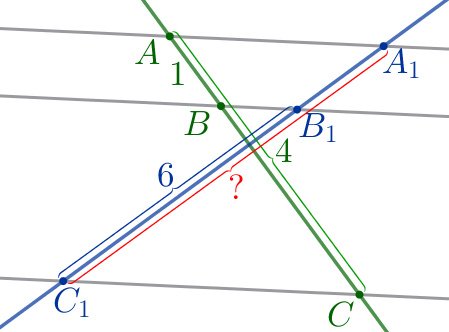 |
Требуется найти длину отрезка \(\displaystyle A_1C_1{\small.}\) |
Так как точка \(\displaystyle B_1\) лежит на отрезке \(\displaystyle A_1C_1{\small,}\) то
\(\displaystyle A_1C_1=A_1B_1+B_1C_1{\small.}\)
То есть
\(\displaystyle A_1C_1=A_1B_1+6{\small.}\)
Найдём длину \(\displaystyle A_1B_1{\small.}\)
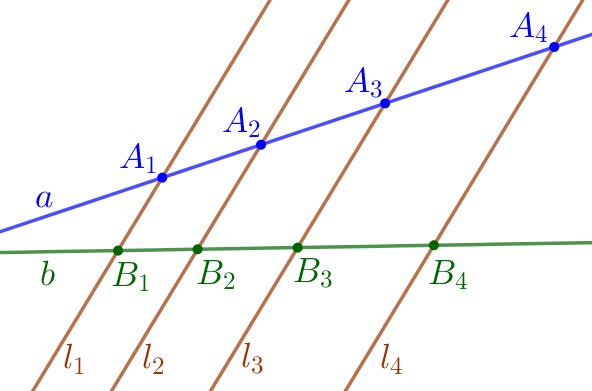
\(\displaystyle \frac{AB}{A_1B_1}=\frac{BC}{B_1C_1}{\small.}\)
Следовательно, по свойству пропорции
\(\displaystyle A_1B_1=\frac{AB \cdot B_1C_1}{BC}{\small.}\)
То есть
\(\displaystyle A_1B_1=\frac{1 \cdot 6}{BC}=\frac{6}{BC}{\small.}\)
Так как точка \(\displaystyle B\) лежит на отрезке \(\displaystyle AC{\small,}\) то
\(\displaystyle BC=AC-AB=4-1=3{\small.}\)
Значит,
\(\displaystyle A_1B_1=\frac{6}{BC}=\frac{6}{3}=2{\small.}\)
В результате получаем
\(\displaystyle A_1C_1=A_1B_1+6=2+6=8{\small.}\)
Ответ: \(\displaystyle A_1C_1=8{\small.}\)