Известно, что в геометрической прогрессии \(\displaystyle b_6 = 1{ \small ,}\) \(\displaystyle q = 3{\small .}\) Найдите \(\displaystyle b_9{\small .}\)
Первый способ
Сначала найдем \(\displaystyle b_7\small,\) потом \(\displaystyle b_8\) и, наконец, \(\displaystyle b_9\small.\)
Каждый член геометрической прогрессии получается умножением предыдущего на одно и то же число \(\displaystyle q{ \small .}\)
Значит, \(\displaystyle b_7\) получается из предыдущего \(\displaystyle b_6\) умножением на \(\displaystyle q{\small : }\)
\(\displaystyle b_7 = b_6 \cdot q=1\cdot3=3{ \small .}\)
Аналогично, \(\displaystyle b_8\) получается из предыдущего \(\displaystyle b_7\) умножением на \(\displaystyle q{\small : }\)
\(\displaystyle b_8 = b_7 \cdot q=3\cdot3=9{ \small ,}\)
и \(\displaystyle b_9\) получается из предыдущего \(\displaystyle b_8\) умножением на \(\displaystyle q{\small : }\)
\(\displaystyle b_9 = b_8 \cdot q=9\cdot3=27{ \small .}\)
Ответ: \(\displaystyle 27{\small .}\)
Второй способ
Девятый член прогрессии \(\displaystyle b_9\) идет после \(\displaystyle b_6\) через три позиции.
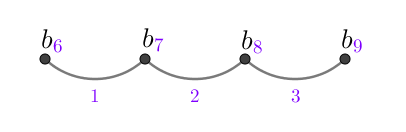
Соседние члены прогрессии отличаются в \(\displaystyle q\) раз:
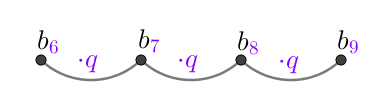
Значит, если умножить \(\displaystyle b_6\) на \(\displaystyle q\) три раза, получим \(\displaystyle b_9{ \small :}\)
\(\displaystyle b_6\cdot q^3= b_6 \cdot q\cdot q\cdot q=(b_6 \cdot q)\cdot q\cdot q=b_7 \cdot q\cdot q=(b_7 \cdot q)\cdot q=b_8\cdot q=b_9 { \small .}\)
Отсюда
\(\displaystyle b_9 = b_6\cdot q^3{ \small .}\)
Поскольку \(\displaystyle b_6=1 \) и \(\displaystyle q=3{ \small ,} \) то
\(\displaystyle b_9 = 1\cdot 3^3= 27{\small .}\)
Ответ: \(\displaystyle 27{\small .}\)